
We Don't Have a Healthcare Data Problem. We Have a Healthcare Network Problem
We don't have a knowledge problem. We have a connection problem. And the difference between those two things is everything.

A few days ago, I published a piece here about why healthcare’s AI ambitions keep failing and the Phase 2 infrastructure void that sits between where we are and where we want to be. What I didn’t realize at the time was that I was living the dysfunction.
What the System Offered
My wife has been dealing with right knee pain for years. Her condition included a lateral meniscus tear and documented cartilage wear. She went through what the system reliably offers: cortisone injections, viscosupplementation, physical therapy. When those stopped working, she had an arthroscopic partial meniscectomy and chondroplasty in 2023. It was the surgical version of smoothing out a rough road surface rather than repaving it. It worked for a while. She hit 15,000 steps a day that summer. We were ecstatic.
Then it stopped working. Her last injection, Zilretta, an extended-release formulation that is newer and supposed to last longer, did nothing for her pain.
I reached out to my orthopedic friends, not as a concerned husband who stumbled upon something online, but as a physician with specific clinical questions. I was advocating for a different type of treatment for my wife. The conversations were collegial but the answers were uniform: debridement, injections, and probably eventual joint replacement.
No one raised the option of osteochondral allograft transplantation. No one mentioned whether biological restoration had ever been on the table. When I raised it directly, they said her arthritis was too advanced. Or perhaps they were too locked in their thinking.
How I Found My Own Surgeon
A few years ago, I had osteochondral allograft transplantation on my own ankle. A surgeon uses donor bone and cartilage, which are intact structural units, to replace damaged tissue that my body could no longer rebuild. For the right patient, at the right time, it can restore function that most orthopedists would say is permanently lost.
It turns out that I was one of these right patients. My outcome was phenomenal. I started running again for the first time in fifteen years. I was skiing within a year of the procedure and probably could have done it earlier if my wife hadn’t forbidden it.
But the way I found the surgeon was less systematic than dumb luck. I happened to cross paths with an orthopedic surgeon who mentioned, in passing, that he knew someone who specialized in exactly this procedure.
This wasn’t a referral. It wasn't a recommendation from a colleague who had already evaluated my case. A chance meeting. A name came up in conversation because I happened to be in the right place at the right time, speaking with the right person. Being a physician probably helped. I move in circles where these discussions occasionally occur. But the honest version of this story is that it was largely happenstance. I just ran into the right specialist who had a friend who was the right subspecialist.
That is both a bit unsettling and also deeply familiar to me as somebody who works in medicine. I know first hand how cutting-edge medicine spreads. We rely too much on dumb luck, word of mouth and chance encounters. There is a web of thin, random threads of professional proximity. We do not have a systematic network. We have islands that patients try to navigate around.
So when my wife’s knee stopped responding to everything the system offered, I didn’t approach my colleagues as someone who’d read an article. I approached them as someone with my personal lived outcome data on what this category of treatment can do. I had a personal case study and the clinical vocabulary to make it land. It still didn’t make much of a difference.
Then I Asked Gemini. And OpenEvidence.
Out of frustration, I did what most physicians would consider beneath them: I turned to consumer and clinical AI tools to navigate my own family’s care.
I want to be precise about what I actually did, because this is where the gaps in the network become impossible to ignore.
I am a physician. I have access to OpenEvidence, a RAG-based clinical reference tool that draws on peer-reviewed literature to answer clinical questions with sourced, evidence-graded responses. I also have more than passing familiarity with how large language models work and how to query them effectively. I combined both, using OpenEvidence to ground the clinical evidence base, then layering that into a structured Gemini query with my wife’s full history, prior treatment course, age, activity goals, and the specific question of what options remained.
What came back was a detailed breakdown of fellowship-trained cartilage specialists in our local area, age-stratified outcome data for various procedures, specific questions to ask at consultations, an explanation of why her meniscectomy history changes the equation, and an honest assessment of what was and wasn’t still possible given where her arthritis had progressed.
Some of it confirmed what the orthopedists said. For instance, MACI, the cell-based regeneration approach, has an FDA-approved age range she has exceeded. But it also identified options the official channels never put on the table, including meniscal allograft transplantation. The output targeted specialists at academic medical centers who focus specifically on joint preservation for active patients in their 60s rather than defaulting immediately to temporizing until she qualified for a joint replacement.
How odd is it that it took a physician, with RAG-based clinical literature access, with working knowledge of how to structure an LLM query, to extract from consumer and clinical AI tools what the formal referral system - asked directly - refused to surface. And how unreproducible. I am not the patient. I am the physician husband. What happens when there’s no one in that role?
The Window
One thing that really bugged us was that we had an opportunity that we missed. MACI, the cartilage cell regeneration procedure with the strongest evidence base for focal cartilage defects, was FDA-approved in 2016. My wife could have qualified for the procedure a few years ago. The window was open during years when she was being managed with injections and eventually arthroscopy. These were years when nobody in the system asked whether those approaches were buying time toward something better, or just buying time.
Nobody told us the window existed.
This wasn't due to a lack of available information. The specialists performing these procedures are at academic medical centers across the country. The clinical literature has been building for decades. The knowledge was there but the network wasn’t.
And here’s the part that should bother you even if your knees are fine: I am a physician with specialist connections, clinical literacy, and AI fluency. Despite this, I stumbled into my own ankle treatment through a conversation with an orthopedist whom I happened to stumble upon. Yet I still needed a consumer chatbot and a clinical literature tool to find options for my wife that the formal system declined to surface.
What happens to everyone who has none of that and doesn’t have the dumb luck I did?
What happens to the 54-year-old teacher whose general orthopedist performs mostly joint replacements and doesn’t think to mention there’s a different subspecialty for this? What happens to the 51-year-old who chose an HMO that doesn’t include the academic medical center with the cartilage restoration program but if he had known and chosen the PPO, he could have had a shot at a life changing procedure? What happens to the patient who trusts, reasonably, that if something better existed, someone would have mentioned it?
They miss the window because the network never reached them.
What We’ve Actually Built
My ankle and my wife’s knee are not different stories about medicine. The procedures exist in both cases. The specialists exist. The evidence exists.
They are the same story about a network with gaping holes.
I found my ankle treatment because I happened to collide with the right information at the right moment, not by design, not through any system, but through the blind luck of professional proximity. My wife went through the official channels: referrals, consultations, a physician husband advocating directly with a personal outcome story…and the official channels failed her.
The difference between our outcomes is not the quality of the medicine. It is not even access, in the traditional sense of the word. It is whether the right knowledge happened to find the right person at the right moment.
In a real network, that doesn’t depend on luck. That’s the whole point of a network.
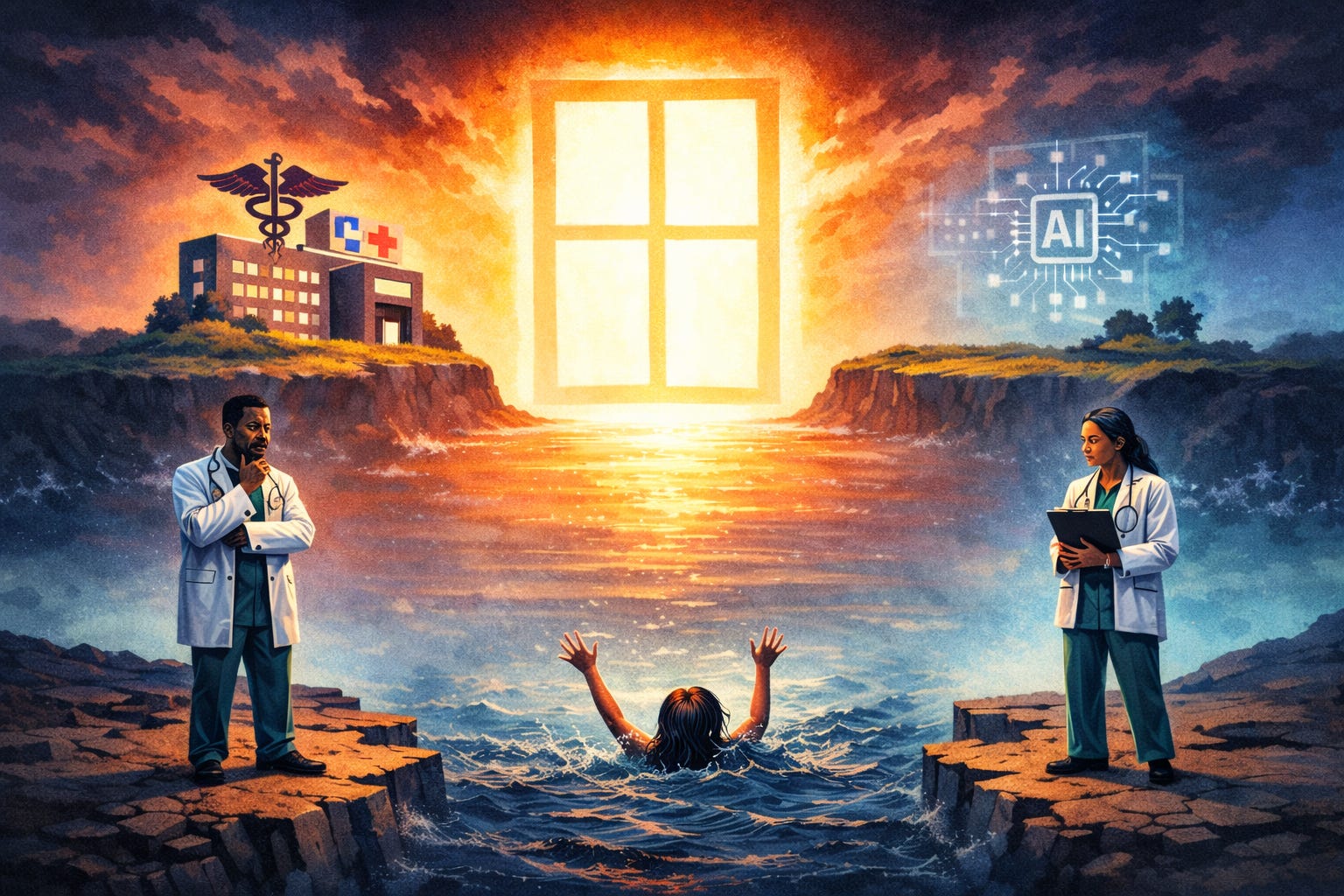
We have heard ad nauseum about siloed healthcare. We have a collection of islands. Specialists on one island, clinical evidence on another, primary care physicians on a third, patients somewhere out in the water. The patient swimming around these islands largely depend on a lot of luck and hope that a boat that helps them to the right island comes by at the right time.
We call it a healthcare system. It is, more accurately, a set of fortunate (and many unfortunate) collisions organized around a billing infrastructure.
Phase 2 Is a Network Problem. And We Now Have the Technology to Solve It.
In my previous piece, I described Phase 2 as the infrastructure void: the missing layer between where healthcare is and where it needs to be. What my wife’s situation made clear to me is that Phase 2 is fundamentally a network problem and hidden solution. The knowledge exists. The specialists exist. The data exists. What doesn’t exist is the connective infrastructure that allows all of it to find the right person at the right moment systematically, reliably, and not by accident.
Before getting into what that network looks like, it’s worth pausing on why this conversation is even possible right now.
The reason I could query Gemini and OpenEvidence and get a clinically coherent, synthesized, personalized answer in minutes is that the underlying technology has crossed a threshold. We can now ingest massive quantities of data like clinical literature, outcomes data, patient history, specialist profiles, procedure-specific evidence bases. The potential can be a focused, synthesized summary calibrated to a specific question. Until now, the ability to reach that potential has been unattainable.
However it is attainable with newer technology. The question is whether we build it intentionally or let it remain a patchwork of tools accessible only to people with the right combination of professional access and technical fluency.
Think about what a real network would have done for my wife. Her messy longitudinal clinical history from multiple positions and systems wouldn’t need to be reconstructed from memory in a chatbot prompt. The network would already know it and then know what to do with it with the full context of the patient’s history.
In such a future, her family practice physician, managing her longitudinal care, would see a patient has progressive cartilage loss who has exhausted conservative options, and is approaching the age threshold beyond which biological restoration becomes significantly less viable. Here are the subspecialists who specialize in joint preservation before replacement becomes the only option, and here is the referral pathway. An actionable flag with a directional next step, surfaced at the moment it’s still useful. Here are the preservation-focused specialists who operate in that space, and here is why a warm handoff now changes her long-term trajectory.
The network shouldn’t require the patient or a physician with OpenEvidence access and LLM fluency to advocate for herself or know what questions to ask in response. It surfaces what she needs to know, in a form she can use, before the window closes. Not because she found it. Because the network brought it to her.
That is the crucial distinction. We talk a lot about patient empowerment: patient portals, shared decision-making tools, health literacy initiatives… The problem is that these place so much of the burden of navigation on the patient. I can’t count the number of decisions I’ve had to make based on fuzzy recollections of patients or a crinkled CT scan report from another facility. (I would say Epic’s CareEverywhere has been a Godsend.)
That is not a sustainable or reliable network.
A real network removes the navigation burden entirely. The right information finds the right person at the right moment—patient, primary care physician, specialist—without anyone having to know what they don’t know in order to ask for it.
The iPhone Didn’t Build a Better Phone. It Built a Network.
When Apple launched the iPod in 2001, it was a genuinely better music device. It replaced the Walkman. But it was still, at its core, a music player. It was better within an existing category, but it did not create a new one.
Its technical descendant, the iPhone, was a different kind of thing entirely. And what’s easy to forget is that when Steve Jobs announced it in 2007, even Apple didn’t fully comprehend what they were building. They thought they were building a better phone with a great music player, a few apps, and an internet communicator. What they actually built was a network node: a device that connected people to people, people to information, people to services, people to each other in ways that remade entire industries and fundamentally changed how human beings move through their lives. The use cases that emerged weren’t planned. The network made them possible and then got out of the way.
Healthcare’s current AI trajectory is iPod thinking. Better clinical decision support layered onto existing workflows: ambient documentation, automated prior authorization and the like. These are real improvements, but they were improvements to existing categories. They do not create something newer or better, just faster.
The Phase 2 I referenced in my last piece should be designed as a genuine network with iPhone thinking. It doesn’t improve the existing referral pathway. It makes the referral pathway’s limitations irrelevant, because when every node in the network is connected to every other node, information finds patients and providers the way it finds people on a smartphone. This process does not rely on the luck of a patient who happens to know someone. This process does not rely on a patient's ability to ask the appropriate question at the appropriate moment. This new infrastructure will route knowledge to where it is needed before anyone has to ask.
And just as Apple couldn’t fully anticipate what the iPhone’s network would enable, we probably can’t fully anticipate what a genuine healthcare information network would produce. A family practice physician flags a closing treatment window before it closes. A patient receives the information that her care trajectory has a fork in the road without asking for it or knowing to ask for it before the window of opportunity causes her to age out before she even knows the opportunity exists. A physician husband doesn’t spend a frustrated evening querying consumer AI tools to find what the system should have surfaced years ago.
Those are the use cases we can see. The network will create ones we can’t.
The technology to build this exists. The data exists (kind of). What has been missing is the architectural intention: the decision to build a connected network rather than a collection of better tools and the commitment to democratize it across every stakeholder it’s meant to serve.
To borrow some Apple marketing lingo, we have to think different but not about the devices. About the network. The goal isn’t a patient who knows how to expertly navigate a broken system. The goal is a system that doesn’t require navigation.
That’s Phase 2. And it’s time to build it.
John Lee is an emergency physician and Epic consultant who helps health systems bridge the gap between Epic’s capabilities and operational reality. He specializes in data architecture, registry optimization, and making Epic’s tools actually deliver results.
If you’re evaluating Epic’s AI announcements and need guidance on implementation strategy, or if you need help configuring your Epic environment to support these capabilities, connect with him on LinkedIn or via his website.
As always an honest insight driven by curiosity and benficience. While this may be feasible, it is not necessarily desirable or viable in the current healthcare ecosystem. It depends on which side of the health care system you are on. What is the primary purpose of the healthcare system? Its core behaviors are extractive and patients are necessary access points to the wallets that pay for their services. Patients are not customers, they are consumers and are playing in a casino where the house is stacked against them. There is no doubt that a consumer would find this desirable, only the biggest, most vertically and horizontally integrated health care system would find it desirable and even then one would question the motives. To be viable, patients would need to be in charge of the wallet, they are not. We need a free market where the best service providers rise to the top because they are visible and outcomes data is based on true value, outcome over cost, benficience and autonomy. I dream of such an open healthcare marketplace.
Another brilliant piece, thanks. Really inspiring. I fully subscribe the need for a network-oriented "architectural intention" so that people, as patients, aren't left "swimming between islands" along their health journeys (and, may I add, healthcare professionals realize that for the most part they operate in weakly connected ones).