
The Epic Sepsis Order Sets Got Fixed. Then So Did Everything Else.


Delivering healthcare is hard. EHRs have inflicted a death by a thousand cuts. These pieces are the sutures.
Part 1 covered how two sepsis order sets, built years apart by people who never spoke, quietly produced two different standards of sepsis care in the same emergency department, and how tagging the library exposed three more dormant order sets sitting one accidental favorite away from becoming the same problem again. This piece picks up where that one left off.
When Sepsis’s Turn on the Staircase Actually Arrives
The value of bucketing isn’t only that it catches conflicts. It’s who ends up in the room when it does. When the sepsis bucket comes up for its scheduled review, the roundtable isn’t just physicians. Pharmacy is there for antibiotic selection and timing. Nursing is there for the reassessment workflow that actually happens at the bedside. Administration is there for the SEP-1 reporting burden. Because every sepsis-tagged order set surfaces at once, sepsis stops being five separate projects run by five separate committees. Instead, it becomes one conversation, with all the stakeholders discussing all the related content simultaneously, instead of whatever order sets somebody’s pet project happened to spin off that quarter.
It is also a different meeting than the one that built either original order set. Nobody in the room is defending a build they personally championed years ago. The physicians who championed Sepsis Bundle — ED and Sepsis / Septic Shock — Adult are both gone. What the group is looking at instead is two active order sets, multiple dormant ones, and a SlicerDicer report showing exactly how the two active sets have been quietly producing two different standards of sepsis care. Nobody needs to be talked into treating this as a problem. The dormant sets get retired outright. For the two active ones, the group doesn’t split the difference and doesn’t pick a winner. They consolidate to a single order set, built once, by the people who actually touch a sepsis patient across the entire encounter rather than by whichever service line happened to file the ticket first.
The consolidation goes past fluids and reassessment timing. The group standardizes antibiotic selection, and, more consequentially, builds a discrete field for the clinical reasoning behind any deviation from a full-volume bolus: cardiorenal risk, early pressor initiation, whatever the clinical picture calls for. That reasoning used to live, if it lived anywhere, in a free-text note a quality abstractor had to read manually to decide whether a lower-volume bolus was a lapse or a documented exception. Discrete data means SEP-1 compliance and exception review can run off a report instead of off chart review, at scale, without anyone reading a note to find out why a physician did what they did.
The outcome gap that opened Part 1 disappears. One sepsis order set serves the emergency department and inpatient now, built against a single, current, cross-disciplinary standard instead of two disconnected ones. The SEP-1 and length-of-stay disparity between Physician A and Physician B narrows to noise.
Tell requestors the truth about the timeline. The part of this that takes actual institutional discipline is what happens when a department wants their order set updated now. The answer, under a bucketed model, is sometimes “that domain isn’t scheduled again until 2030.” That is not a popular thing to say to a service line chief who is convinced their request is urgent. But the alternative, the ungoverned status quo, produces exactly the failure mode that opened Part 1: two well-intentioned builds, never reconciled, quietly producing different standards of care along with others sitting dormant like landmines waiting to wreak havoc. A defined escalation pathway still exists for genuine safety issues. Everything else waits its turn, and requestors are told exactly when their turn is, instead of disappearing into an unbounded queue where, in practice, many requests are simply never done at all.
The Number That Made This Worth Doing at Scale
Sepsis was the proof of concept, not the destination. Once the bucketed review process was running, it didn’t stay confined to one clinical domain. Neuro’s turn came. Then anesthesia. Then general medicine, cardiology, and the rest of the staircase, one scheduled domain at a time, the same freeze-then-organize-then-bucket sequence sepsis had gone through, run on a fixed cadence instead of reinvented from scratch each time.
Two years in, the order set library that opened Part 1 at nearly 1,000 records stood at 350. Every domain that came up for review found its own version of the sepsis pair: duplicates built by committees that never spoke, dormant sets nobody had gotten around to retiring, order sets built for programs that no longer existed. Bucketing didn’t just catch sepsis. It caught the same failure mode everywhere it had been quietly accumulating for a decade.
The library shrinking isn’t the interesting number. Multiple quality metrics moved with it, and order set utilization increased. Physicians used the governed order set instead of building a personal workaround or defaulting to whatever their favorites list happened to hand them, because the governed version was now the one that actually reflected current practice.
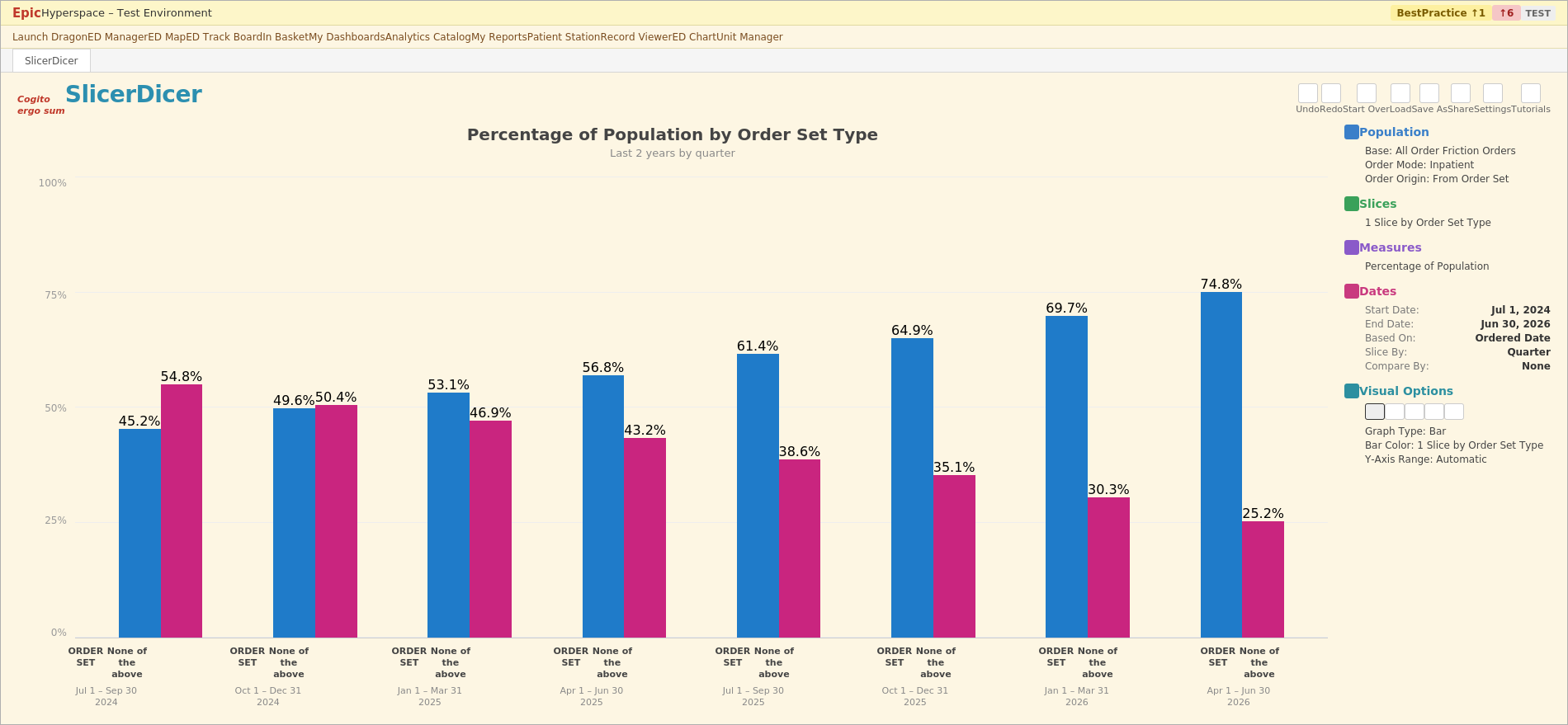
And the same SlicerDicer order friction model the ED director had used to crack the sepsis case, run across the whole library two years later, turned up something nobody had specifically set out to measure. Time in order, the friction between opening an order set and completing it, dropped substantially across the board. For orders built from a governed order set specifically, time in order fell under two seconds.
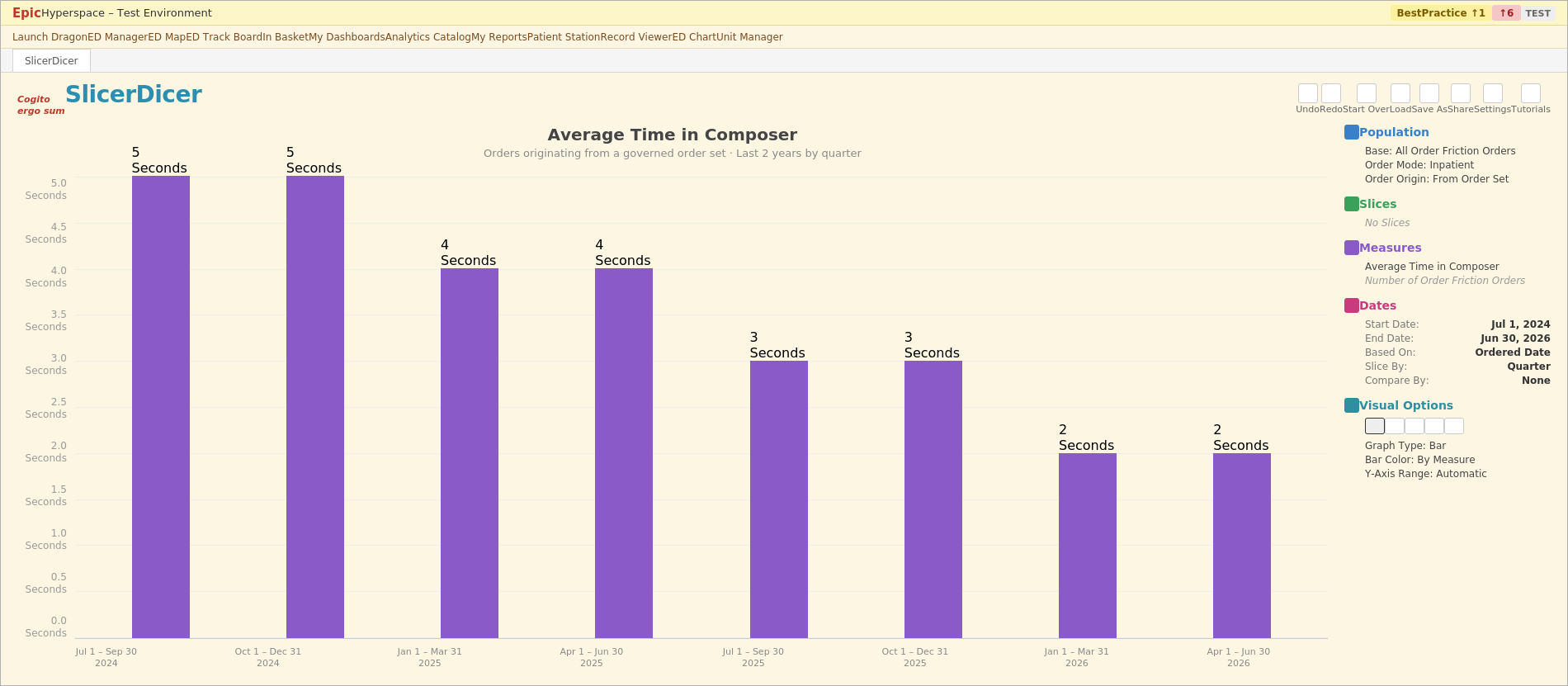
That’s the actual case for doing this at scale, and it isn’t the one most governance pitches lead with. The case isn’t that governance catches conflicts, though it does. It’s that a library people can navigate quickly is a library people actually use as built, instead of routing around it with favorites, workarounds, and whatever happens to load fastest at 3 a.m. Ad hoc governance discovers conflicts by accident, usually after an outcome gap has already accumulated, like the sepsis example. Bucketed governance discovers them by design and, it turns out, makes the whole system faster to use in the process.
So What
The dollar-and-outcome version of this is straightforward. SEP-1 compliance is a CMS-tracked measure with real reimbursement exposure. Sepsis length of stay compounds across every bed-day the hospital is carrying a patient who could have been discharged sooner under a more consistent protocol. Sub-two-second time in order, multiplied across a two-year rollout and every domain on the staircase, is the kind of number that never makes a quality slide but shows up in every physician’s shift regardless. But the better number is still the one that’s harder to put in a slide: how many other order sets, right now, in your build, are quietly doing what the sepsis pair did for eighteen months, producing two standards of care under one roof because two tickets got processed by two analysts who never had a reason to talk to each other, and how many more turn up the moment somebody actually looks.
This is the third time this series has landed on the same underlying diagnosis at a different layer of the Epic build. The OPA piece found it in alert governance. The grouper piece found it in cohort definitions. This piece finds it in order sets, and finds that fixing it at scale pays for itself in more than just avoided outcome gaps. The pattern is not a coincidence, and it is not specific to any one content type. It is what happens anywhere Epic lets multiple people build independently against the same clinical concept, with no metadata architecture forcing those builds into the same room before a patient ends up on the wrong side of the divergence.
If nobody in your organization can tell you which sepsis order set — or any order set — your physicians actually default to, and why, this is exactly the kind of Epic problem I work on.
I run a 30-minute Epic Strategy Review. A working conversation, not a pitch. You describe the specific Epic problem you’re wrestling with, I tell you what I see, and by the end of 30 minutes we land in one of three places: a natural next step, an honest “you don’t need me yet,” or a clean “not a fit.” Book some time here.
John Lee is an emergency physician and Epic consultant who helps health systems bridge the gap between Epic’s capabilities and operational reality. He specializes in data architecture, registry optimization, and making Epic’s tools actually deliver results.
Also on LinkedIn and at hitpeakadvisors.com.