
Epic Won the EHR War. Will it Lose the Front Door?
Epic's Real Competitor Isn't an EHR. It's a Whoop and an Amazon Visit.

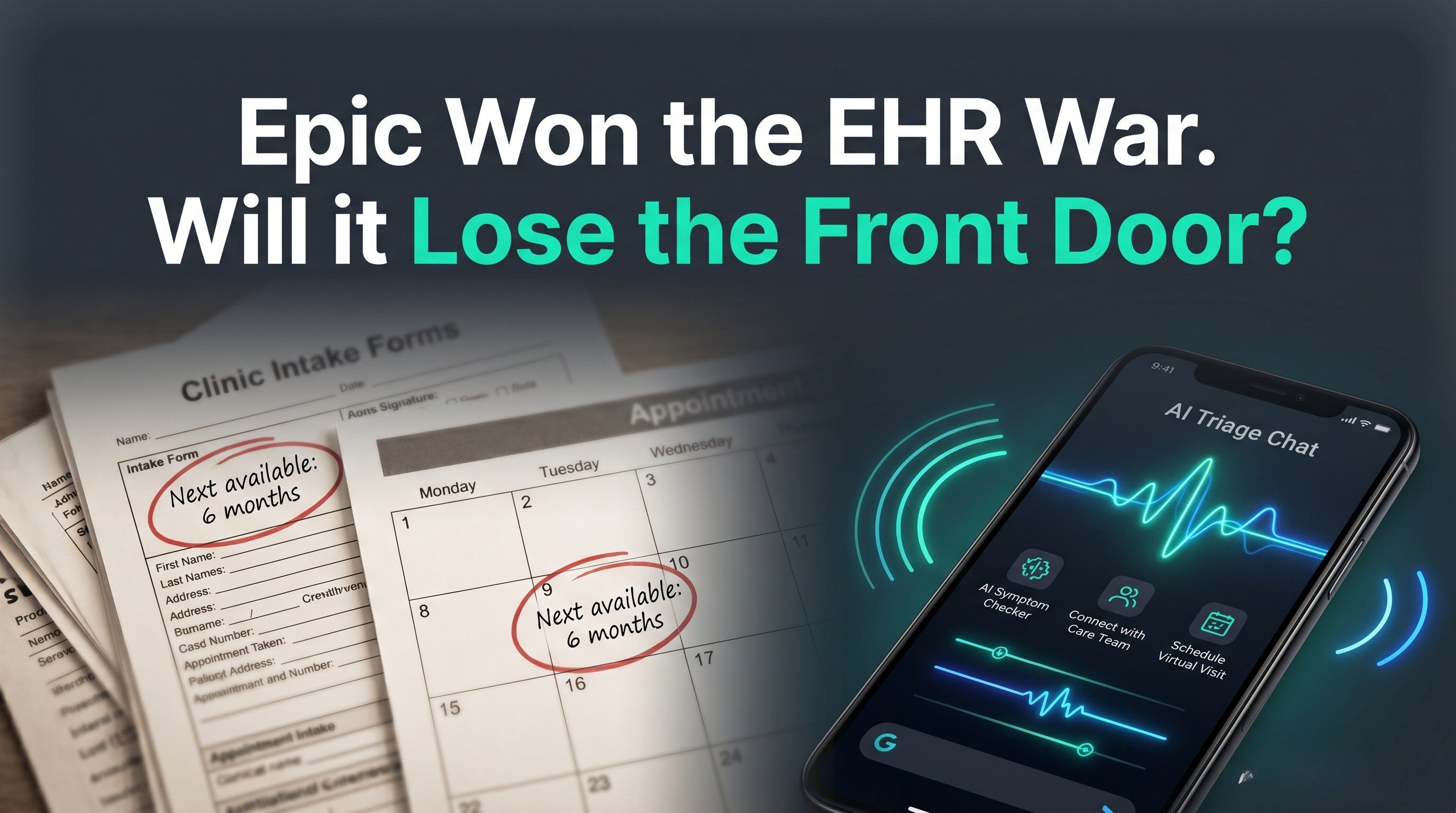
You probably know someone who tried to get a primary care appointment and gave up. You might be that someone. Six-month waits are not the headline anymore. They are the baseline.
Christian Pean wrote a quasi-satirical Substack last week describing what patients are doing about it. A Whoop on the wrist for the daily signal. An annual Quest panel booked out of pocket. An Amazon One Medical visit when something needs a prescription. Christian is a physician. He is highly technically adept. He is a patient who stopped waiting for the institutional path to deliver. He is not the only physician I know who has assembled some version of this.
I commented under his LinkedIn post noting he was describing the opt-out more and more of my busy professional friends are already moving toward on their own. They are not waiting for the system to fix itself.
I am an emergency physician. Inside my own health system I can still get appointments quickly because I know people. The moment I step outside, the superpower evaporates and I see what everyone else sees. The patients in Christian’s stack are not waiting for the inside-the-walls superpower I happen to have. They have built a different one.
A few months ago I wrote about a conversation with a colleague’s granddaughter. The 10 year old granddaughter had used AI to put together her travel packing list. She thought nothing of it. AI was just what she reached for. I described her at the time as a kryptonite Epic does not see, because the generation that defaults to AI for a packing list will default to it for symptoms and access, and Epic’s customers are health systems that still think the patient is the person who eventually always shows up.
Christian’s piece is the same idea aged forward by a generation. The kryptonite is no longer hypothetical. It is operating. It has a payment model that mostly works for affluent users. And it has people like Christian as customers, while the systems I help configure are still building for the person who eventually shows up.
Clayton Christensen Doesn’t Care That You Tried Hard
There is a specific failure mode in Christensen’s disruption framework that fits this exactly. Incumbents do not lose because they fail to innovate. They lose because they deliver sustaining innovation that produces immediate value for their current customers, while the insurgents disrupt and serve customers the incumbents have chosen to ignore. The incumbents are rational. They have names like Blockbuster and Blackberry.
Read the AI roadmap of any large health system in 2026. The investments are in ambient documentation, agentic workflow automation, scheduling optimization, and clinical decision support that fires inside the existing encounter. Every dollar is making the existing front door slightly less broken. Better notes. Less cognitive load. Faster portal responses. Sustaining innovation, top to bottom. The patient who can still get a visit will have a marginally better visit.
The patient who waited six months and gave up is real. Christensen is not asking about that patient. What he is doing is targeting the one who never picked up the phone in the first place. AI is there, AI is fast, AI is what they reach for. That patient is not in any of these AI strategies. That patient never showed up in your data at all.
The Pattern Repeats: Faster Horses, Bigger Stakes
I have written before that healthcare AI keeps building faster horses. Ambient AI that produces better-sounding versions of the same discharge note. Agentic AI that compresses an existing committee process into an afternoon. Each layer is credit-worthy on its own. Each one assumes the existing factory floor is fixed.
The pattern shows up at the institutional level too. The patient encounter, the office visit, the prescription workflow, the referral, all treated as immutable infrastructure that AI gets to make less exhausting. Every roadmap reduces friction inside the existing structure. None of them asks what the encounter, the role, the cadence look like when ambient capture, agentic action, and AI-mediated triage are assumed as primitives.
The insurgents are not building faster horses. They are building a different vehicle. The encounter is asynchronous and AI-first. The provider is a fallback, not a starting point. The data comes from a wrist sensor and a finger-prick panel, not a clinic intake form. The factory floor is being redesigned, off-site, by people who never agreed to call your scheduling line in the first place.
I Have Been Arguing From Inside While My Friends Quietly Walked Out
I admittedly have conflicts when talking about this.
I make a good living inside the system I am describing as disruption-ready. My consulting work is in Epic optimization. The health systems I help are the ones Christensen says are about to be in trouble. Every dollar I have made in the last 2 decades has come from making the existing infrastructure work better.
I also still work clinically in an emergency department. A meaningful share of my patients are there because they could not get an ambulatory appointment in time. The system pays me to optimize the dysfunction. The same system sends me the patients it failed to absorb upstream.
I have spent the same two decades arguing from inside that infrastructure that better data is the path to a better system. I still believe it. I also have to admit that better data has not arrived at the speed the patients have left. Christian is gone. Many of my professional friends are gone with him. The institutional system I help configure does not know about most of the data those friends are generating, and there is no path on any current roadmap for it to know. The argument I have been making from inside has not kept pace with the defection happening outside.
That is the part the systems I consult for should worry about. The wave is not waiting for the current players to change. The disruption does not require the people inside to declare that they are leaving. All it needs is for organizations to stop noticing what the people behind them have already done.
The Blockers Are Real and Most of Them Are Data Problems
There is a flip side. The disruption is not inevitable. Christian and the friends I see migrating, are trending at the edge. But migration is not proof of a tipping point. There are real blockers. Most of them are not technology. All of them are realities that are regularly underestimated by boosters.
The first is payment. The opt-out works for Christian and my friends because they can afford it. Whoop is a subscription. Quest is out of pocket if you book it yourself. Amazon One Medical Virtual Care is a layer on top of Amazon Prime. The current payment system does not facilitate routing primary care at scale through this stack. Insurance pays for the office visit it cannot deliver. It does not pay for the asynchronous AI triage that would actually solve the access problem. Until payment moves, this is a premium experience for the affluent, not the new front door for the population. People will pay for premium AI care. The number who will is small enough that it does not tip the scales on its own.
The second is data standards. An Apple Watch EKG reading and a Kardia device reading may look qualitatively similar but they are not the same. Anyone who has worn a heart rate monitor knows the same device produces meaningfully different numbers depending on fit, motion, and ambient conditions. Across devices the variance is worse. An AI triage layer that ingests sensor data has to normalize across devices, fits, sampling rates, and quality grades, and as of 2026 there is no industry standard for what good enough means in that normalization. Whose readings count as diagnostic? Whose are advisory? Who certifies the device-to-device equivalence? The boosters seem to trust that a heart rate is a heart rate, regardless of the source. The clinicians who would have to trust the output cannot.
The third is subjective data. The visit-replacing AI has to interpret what the patient says, not just what the sensor measures. The same complaint phrased two different ways or the same verbiage by two different patients may route to two different places. Or it may not. How are we supposed to discern? Ambient AI is starting to capture the conversation, which is real progress. Interpreting it at the level required to triage safely is a different problem than transcribing it accurately.
The fourth is aggregation, interoperability, and privacy. If the stack lives outside the EHR and outside the health system, where does the data go, who owns it, and how does it move? Right now, it mostly does not move. Each vendor speaks its own format, and there is no incentive structure pushing for standards. The consumer-tech precedent on ownership is not encouraging either. The free service almost always means the user is the product and there is financial incentive to hold on to the data. Even the paid services are negotiating data rights in fine print most users never read. HIPAA, by design, does not cover most of this layer. Whoop is not a covered entity in the way your hospital is. The AI triage company you might one day route your symptoms through is not either. The patient gets convenience now and an unclear exchange for it later.
The fifth is accountability. My core premise across everything I write is that good data produces accountability. The corollary is harder to face. If the data flows into a well-marketed AI black box, the accountability does not follow. A great-sounding triage app that quietly misses a presentation pattern in a population it was not trained on is harder to surface than a misread chest X-ray, because there is no chart to audit and no licensed provider whose name sits on the decision. The disruption is real. The accountability infrastructure to govern it is not.
The sixth is that even the simple cases are not as simple as the marketing suggests. An AI provider automatically approving prescription refills on prescriptions that already exist sounds like the easiest possible win. Utah ran a version of this using the Doctronic system. The execution was more complicated than the announcement, the edge cases were not edge, and the rollback was instructive. I am not a Doctronic expert and I am not going to issue a clean verdict on the effort. I am willing to say that the most boring possible AI use case in primary care turned out to be harder than its proponents told the legislature it would be.
What the Window Is Actually For
None of these blockers stop the disruption. They slow it. Christensen’s framework predicts that incumbents have a window between when the insurgents become visible and when the tipping point arrives. The incumbents almost always use that window to optimize the wrong thing.
Right now health systems and legacy EHRs are using the window to build faster horses. Better documentation. Less cognitive load. Smarter alerts inside the existing visit. The work is real and the work is sustaining. None of it substantially addresses the patient who tried for six months and stopped trying.
The pivot would look like accepting that the front door is being rebuilt outside your walls, and asking what role you want to play in a world where asynchronous AI triage is the first contact and your physical infrastructure is the escalation tier. That is a different strategy than the one anyone is publishing.
I am the consultant asking you about your customer base. A physician who makes a living inside the system, who has been arguing for the changes that would make the consumer stack unnecessary, who is watching the argument lose to the speed of the patients. I am rooting for the institutional path to close the gap from your side, because the alternative is that more of healthcare migrates to free services that monetize patient data, governed by an environment where HIPAA does not apply, ruled on by an accountability infrastructure that does not yet exist.
Christian is already gone. The granddaughter I wrote about a few months ago was born into the alternative. The system you and I are building inside has a year, maybe two, to make the institutional path the easier one to take. The window is closing on its own timeline, not yours.
John Lee is an emergency physician and Epic consultant who helps health systems bridge the gap between Epic’s capabilities and operational reality. He specializes in data architecture, registry optimization, and making Epic’s tools actually deliver results.
If you need help configuring your Epic environment to support these capabilities, connect with him on LinkedIn (https://www.linkedin.com/in/johnleecmio/) or via his website (https://www.hitpeakadvisors.com/).
Great piece, John, the best I have read to capture this inflection moment in health care. While you concentrate on our US situation, the ROW faces the same disruptive forces, often at even greater urgency. I expect to see mass affordable AI solutions pop up in Asia & Africa sooner than here and these solutions may end up immigrating into the US to solve our similar problems.
Very interesting piece, thanks. While I largely agree with the overall picture of disrupting forces you paint, I’m skeptical that the AI-driven “runaway consumer” trend can by itself effectively displace the current HC delivery model at scale (only, as you mention, for a tiny slice of the population with the means for a significant alternative). Plus, we cannot underestimate the stalling power of the incumbents.
Moreover, I don’t think the alternative to the EPIC-based paradigm should necessarily be an OpenAI-based one, with the attendant features of advertising-based revenue toward customer capture and a rent-seeking platform. The roadmap is complex and there are no easy solutions; I suggest, as a premise, that PHI individual ownership by the citizen must be not only legally acknowledged but operationalized, with personal agency (and privacy !) supported by AI with the significant governance infrastructure that will entail. The “wave” you mention will have to somehow bridge the receptive field of a person’s life with the institutional resources of the medical-industrial complex it will still depend upon, and support the critical feedback loop between the individual (who communicates need and may provide RWD) and the collective, where evidence-based knowledge is generated and proactive population health may be enacted.