
Epic Didn’t Win the EHR Wars. Its Competitors Lost Them.
I Recommended Against Epic. They Chose It Anyway. That Worries Me.

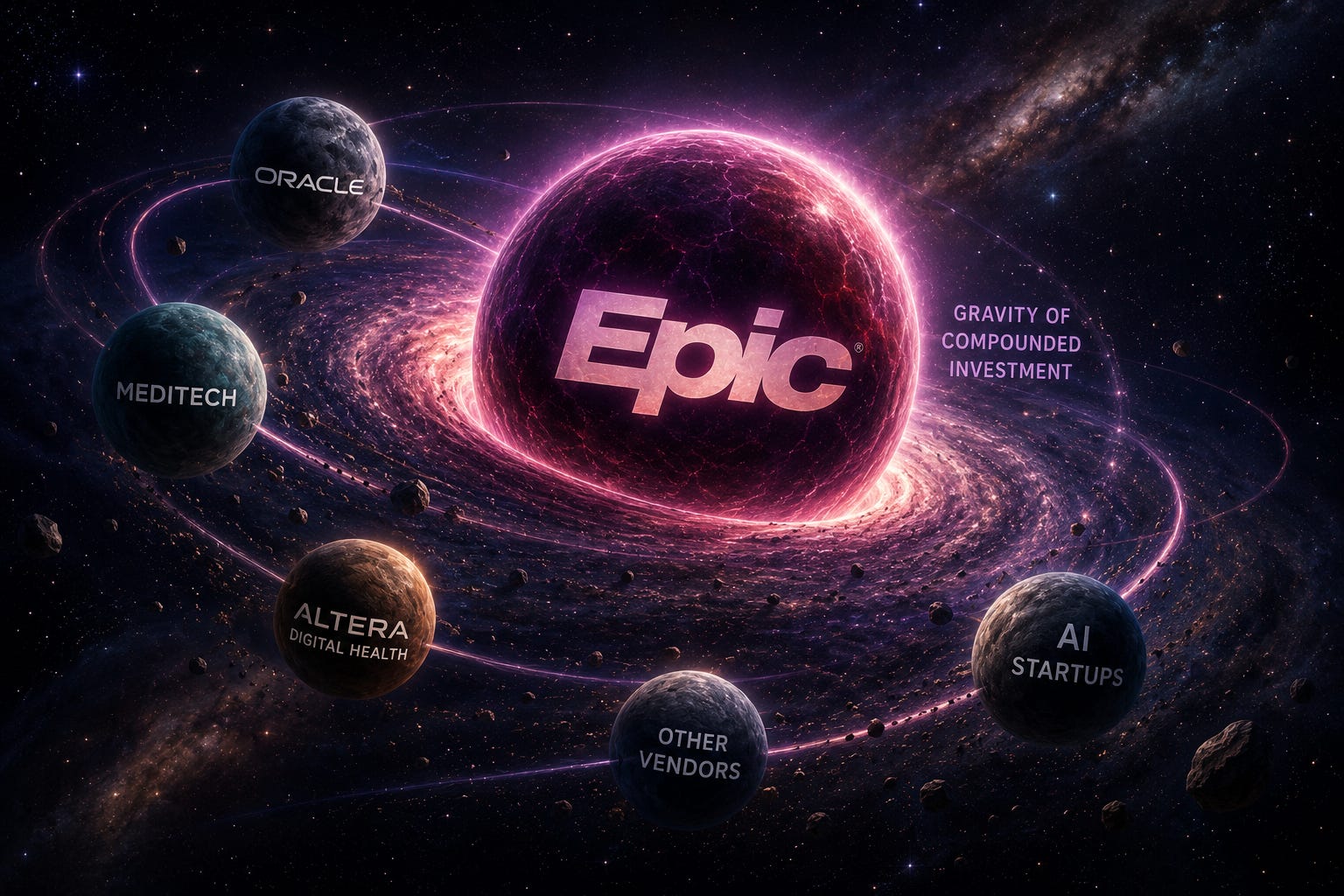
Another week, another Becker’s article on Epic’s dominance. Although this may be beating a dead horse, this article surfaces just the end results. I think it is more worthwhile looking at why the EHR market has gotten to this place. And despite what you may think, I am actually rooting for other vendors.
Allscripts bought Eclipsys to create an enterprise system that theoretically merged one inpatient EMR system with an ambulatory system to create a system that could follow a patient seamlessly from the clinic to the ICU. Cerner bought Siemens Health Services and a host of other systems to create a theoretical enterprise juggernaut. The theory behind each acquisition was coherent. Epic was winning because it offered an integrated platform, and the way to compete was to buy integration. What their competitors built instead was technical debt at a scale that took years to fully appreciate — a digital Tower of Babel of codebases, incompatible data models, and leadership attention divided across systems and cultures that had no business being in the same company.
Epic’s answer to acquisition was inexorable internal R&D. No counter-acquisition. No mergers. Just more engineers, more investment, more product. CEO Judy Faulkner has stated publicly that Epic reinvests roughly 50 percent of its operating expenses back into R&D, a ratio she contrasted against Cerner’s then-19 percent. More recent estimates put the Epic figure somewhere between 30 and 50 percent of revenue. Against a revenue base estimated at roughly $5.7 billion in 2024, that implies somewhere between $1.7 and $2.9 billion in annual R&D spend. No other EHR vendor is close on an absolute basis.
Oracle, which acquired Cerner in 2022 for $28 billion, reports corporate R&D of roughly $9.86 billion for FY2025. That number looks competitive until you understand what it covers: cloud infrastructure, Fusion ERP, NetSuite, database products, and Oracle Health all drawing from the same pool. Oracle Health represents roughly 10 percent of Oracle’s total revenue. Apply that share to the R&D budget and you get approximately $1 billion attributed to healthcare — and that assumes health wins its internal capital allocation fight rather than losing it to Oracle Cloud Infrastructure.
Altera Digital Health, the former Allscripts assets now owned by Constellation Software, operates inside a parent company whose explicit strategy is acquire-and-optimize, not innovate. Constellation’s R&D intensity across its roughly 500+ vertical market software subsidiaries runs at about 14 percent of revenue. Altera is just one of those 500.
The structural R&D gap between Epic and its nearest competitors is not a recent development. It compounded over a decade while those competitors were trying to equate “enterprise” with “acquisition.”
The Bet That Was a Head Scratcher for Eight Years
An example of this development is Cosmos, which, to many, started as a curiosity. When Epic first described a federated research database drawing from its installed base, the use cases were interesting but narrow: academic researchers, population-level studies, tools that served a small fraction of the clinical enterprise. For years, it consumed extraordinary investment and returned zero revenue. I know from personal communication that the spend has been massive, and that for much of its life Cosmos was a loss leader that required the kind of institutional patience that a publicly-traded company board with quarterly earnings pressure would never approve.
That patience is now becoming a moat.
There are now tools like Patients Like Mine which gives clinicians a way to query outcomes across the Cosmos patient population. Antibiogram tools began to use that aggregate data to surface infection patterns that no single institution could detect alone and do it far faster than public health mechanisms.
Most importantly, these tools are going from niche to having ubiquitous utility. For example, the Cosmos Median Length of Stay tool is doing something that matters operationally: it benchmarks each admission against comparable patients across the Cosmos network and produces an accurate estimated discharge date from the moment a patient is admitted for every patient admitted. This give discharge planning teams the information they need to route limited resources to the patients who will need help leaving tomorrow rather than a week from now. Saint Luke’s in Kansas City used it to shave half a day off their average length of stay. Across a system with thousands of beds, half a day average improvement is not a rounding error. Length of stay is one of the most expensive operational variables in a health system. A tool that tells you not just what your median LOS is, but what it should be given your specific patient mix, drawn from real clinical data across comparable institutions, is worth significant cost savings to a CFO. It is not a research tool. It is an operational intelligence tool. And it exists only inside Epic.
Cosmos is where the moat starts, not where it ends. Epic is building the next internal iteration — Curiosity, which transforms Cosmos data into predicted patient events, is what comes next — that will generate clinical workflow tools without the interoperability friction that external AI vendors will spend years fighting. The compounding advantage is not just the data. It is the network effect of data across all Epic organizations and the rate at which that data cycles back and improves embedded workflow.
As Epic weaves AI into Cosmos, the trajectory comes into focus. What is being built is not a better EHR. It is an orchestration layer for clinical operations, one that will know what good looks like across thousands of institutions and surface that knowledge immediately and directly in your workflow, in real time. No competitor is building this, because no competitor has the data to build it. The data advantage and the R&D advantage are compounding in the same direction at the same time.
What the Gravity Actually Feels Like
I am openly in the Epic sphere. People who know my work know where my bias sits. My consulting practice is built around helping vendors and health systems get Epic right, and I have seen the gap between Epic done well and Epic done poorly.
Recently I consulted for a smaller health system. The implicit expectation when they brought me in, I think, was that I would make the case for Epic. I didn’t. I looked at their size, their resource constraints, their particular operational circumstances, and recommended Meditech combined with a limited Epic Community Connect instance for their clinics that fit their situation well. It was the right recommendation for that organization. They chose Epic anyway.
I think it will go poorly for them. Not because Epic is a bad product or that they are a bad IT shop. There is a version of the 1980s IT mindset at work here: “Nobody ever got fired for choosing IBM.” In healthcare IT, that has become, “Nobody gets fired for choosing Epic.” I have seen some genuinely bad Epic implementations, and I have lived inside some genuinely good Meditech ones. The KLAS Arch Collaborative data supports this. If you have the resources to implement Epic well, it is a fantastic solution. Meditech has a lower ceiling. But a good Meditech implementation beats a bad Epic one, and resource-constrained organizations underestimate that gap at real cost.
What I keep thinking about from that engagement is not the outcome, which I couldn’t control. It is the dynamic. Sound analysis and correct recommendation were overridden. Not because anyone disagreed with the analysis but because Epic’s gravitational pull in the market is now strong enough to overcome it. When institutional momentum overrides reasoned evaluation, the problem is not the evaluation.
Earned Dominance Is Not the Same as Healthy Dominance
Epic’s position is not a conspiracy and it is not an accident. Its competitors had the same decade to build. They chose acquisition over integration, short-term scale over compounding R&D, and external growth over internal investment. Epic made different choices and the market reflected those choices. The instinct in healthcare IT is often to frame Epic’s dominance as something done to the market by Judy. It was not. The market was open to anyone willing to do what Epic did: stay private, reinvest aggressively, make decade-long bets on platforms that lost money for years before they paid off.
But earned dominance and healthy dominance are not the same thing.
A market with one serious option is a market where purchasers lose negotiating leverage, where innovation is dictated by a single vendor’s roadmap, and where the failure modes of that vendor become the failure modes of American healthcare infrastructure. Three viable options is not an unreasonable floor.
I am rooting for competition. Personally, I am rooting for Meditech, a company that has stayed independent, has consistently earned Best in KLAS recognition alongside Epic, and has not tried to grow by acquisition. They have done unglamorous work and done it well. I have also heard signals, from conversations rather than press releases, that Oracle may be finding its footing after a difficult post-acquisition period. I don’t have the same technical intimacy with Oracle that I have with Epic and Meditech, so that intelligence is a bit loose. Still, what I’ve heard is encouraging.
The window is not closed but the window is narrowing, and development like Cosmos is what will close it.
A health system considering alternatives to Epic today is already weighing substantial switching costs: data migration, workflow rebuilds, retraining, the accumulated optimization work embedded in years of build. That argument has always been real. What Cosmos and other near term development adds is a second dimension to it. Switching away from Epic in five years will not just mean leaving your EHR. It will mean leaving the only platform that can tell you what your clinical outcomes and operational performance should look like, drawn from a patient population base that no competitor can replicate. And be able to do all that without dealing with a host of third-party vendors.
Interoperability regulations addressed raw data portability. They did not address intelligence portability. You can export your records. You cannot export the benchmarks. You cannot export your synthesized enterprise knowledge and wisdom.
For healthcare executives making platform decisions today, that distinction matters. The question is not only whether Epic’s current capabilities justify its cost. The question is what the opportunity cost looks like in 2030, when Cosmos is mature, and it along with the rest of Epic’s tools are AI-enabled, and embedded in how clinical and operational decisions get made.
Epic didn’t win by doing anything its competitors were not able to do. It won because its competitors were unwilling to do it.
Other than an AT&T or Microsoft-like antitrust effort, there is no regulatory fix that will bend the trajectory. The intelligence that Cosmos generates — and that Agent Factory and the rest of Epic’s proprietary tools will generate — is far more proprietary than most people realize, and it is hard to imagine a rule that forces Epic to make any of it public domain. Given Epic’s continued dedication to R&D, the moat only deepens from here.
What that produces is a tipping point. At some threshold, extracting from Epic becomes too expensive and too painful, and because everyone else is on Epic, no one leaves. The market closes. Not because anyone decreed it, but because the math of staying overwhelms the math of leaving for every individual organization making the decision in isolation.
That is the question executives should be considering. Let’s not expend our energy arguing whether Epic deserves its position — it does. Let’s figure out if the current trajectory of that position leaves room for the kind of competitive market that healthcare actually needs.
---
John Lee is an emergency physician and Epic consultant who helps health systems bridge the gap between Epic’s capabilities and operational reality. He specializes in data architecture, registry optimization, and making Epic’s tools actually deliver results.
If you need help configuring your Epic environment to support these capabilities, connect with him on LinkedIn or via his website.
Question is how “entrepreneurial” will Epic Cosmos joint owners be in building an internal sharable AI clinical decisions support tool integrated with MyCharts that would totally outshine external single point solutions from Open Evidence or Doximity?
From your description it’s clear Epic is in a very strong position with respect to its direct competitors. My bet, however, is that its value proposition is inexorably a losing one because no health system, being the critical societal infrastructure it is, can afford to have a private quasi monopolist hoard and leverage health data as a proprietary asset. Epic’s competitive position can and should be thoroughly shaken by disruptive innovation, which in my view must come from new market entrants ready to navigate the blue ocean of a person- (rather than provider-) centric architecture. Those would in effect be “competing against non-consumption” (to use Clay Christensen’s phrase), with two strategically important implications: enabling the much needed disintermediation of the health care provider between the individual (the population in aggregate) and research and public health operations (ultimately impacting policy making capabilities), which we can understand as the current system’s fragmentation at a macro level; and leading the HC provider to a wise scaling down of its information management scope in which it tries to optimise its resources for service delivery as it participates in a personal longitudinal process it no longer owns (which currently sustains the micro fragmentation of one’s personal health record). The mission of any health system — to serve the community under its jurisdiction with better outcomes in a sustainable way — is essentially incompatible with Epic’s business model. A Personal Health System, made feasible by machine learning (natural language-based interface and more), security-enhancing technologies and personal data storage solutions, should be what “solves” for the public good whatever moat Epic’s owners may enjoy now, to the benefit of the citizen, the HC professional, the researcher and society at large.