

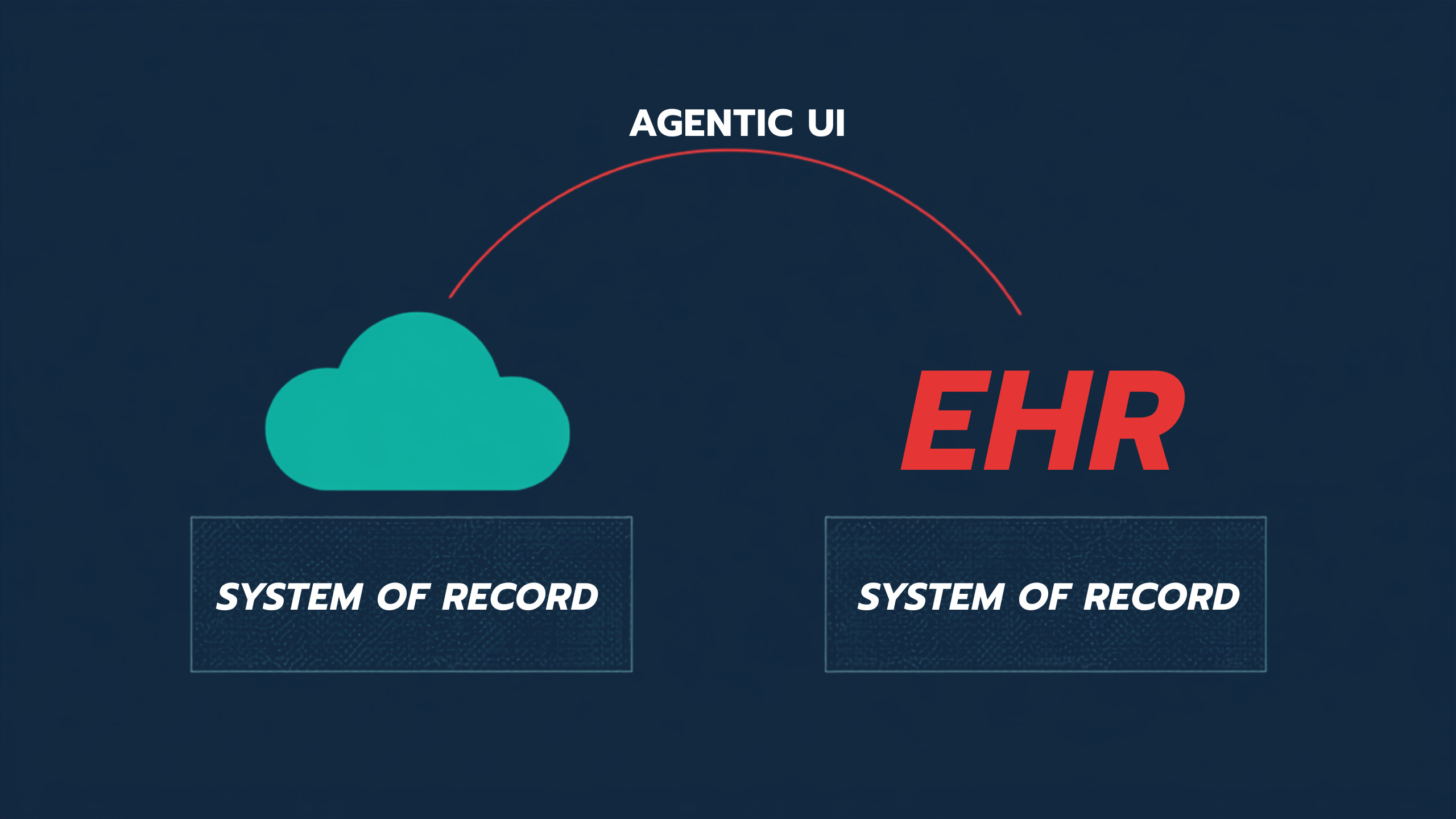
I was recently listening to the All In Podcast and the Besties were discussing Salesforce and the SaaS-pocalypse. Claude code was going to allow businesses to create bespoke software and make SaaS obsolete. Salesforce was doomed. Interestingly, on his earnings call, Salesforce’s CEO, Marc Benioff, said something unusual. He described how he plans to let Claude take over its customer-facing interface. Claude becomes the front end. Salesforce becomes the source of truth foundation. Wall Street’s response was not to punish him for capitulating to Claude. Salesforce closed up over 20% on the week, on a quarter Chamath Palihapitiya had previously called out as “meaningfully oversold.” The SaaS-pocalypse evaporated.
Why is an Epic informaticist talking about this? I wrote last week about Epic’s Agent Factory connectors and the All In Podcast sounded eerily familiar. Then OpenAI announced their connection with Epic. What I see is Epic building an application layer on top of their Chronicles system of record. Benioff’s earnings call described the Salesforce version of Agent Factory and its Connectors.
The MUMPS Objection
Before getting to what the layering model means for vendors, I want to address the vibe coders out there convinced that they will leapfrog Epic’s circa 1966 MUMPS computer language. There is a subset of physicians and programmers out there who think that 2026 vibe coding will run circles around MUMPS and it’s obvious that NYU needs to buy their garage-coded EMR. Go for it. I don’t think you’ll get very far. The people making this argument are not dumb, but they are wrong about what actually makes a system of record durable and why orgs choose them.
On the podcast, David Sacks made the case that no core system of record gets ripped out and replaced by something vibe-coded, because enterprises want certainty and compliance, and because a probabilistic tool built in a weekend hasn’t been through the crucible of years of bug reports, edge-case handling, and regulatory validation.
These are mission-critical systems that have outlasted the game of enterprise Survivor. The code’s age or even theoretical obsolescence was never the point. Cobol runs the backbone of global finance for the same reason MUMPS runs the backbone of American healthcare: the language is not the asset. The asset is twenty years of institutions finding out exactly where the system breaks, and the vendor fixing it because it’s their liability. A freshly built EMR, vibe-coded or otherwise, has none of that. It has not been wrong in production a million times and has learned from it. It has not survived a Joint Commission audit, a ransomware attempt, a mass-casualty surge, or a decade of ICD code set changes. We should not confuse an argument about computer language with an argument about trust. Vibe coding vertical SaaS ends up being a tool that ships fast that looks like disruption but is actually just untested.
The Layering Model, Not the Replacement Model
The framing that came out of that Salesforce earnings call, and on the podcast, is that we should be thinking of this interplay of AI and systems of record as a stack. The system of record is on the bottom, applications and workflows on top of that, agents on top of the workflows, and now an AI layer that will increasingly function as the user interface. Benioff’s bet is that he doesn’t need to own that top layer. He needs to own the base layer that the top layer has to trust.
That’s the same bet I think Epic is making on Agent Factory. One thing to note that many might have missed is that much of the new software recently built by Epic has been using a version of Agent Factory internal to the Epic development teams. The next transition is to start letting Epic orgs get their hands directly on the toolset this fall.
Agent Factory’s MCP connectors will allow external tools to interact with the canonical Chronicles and Cosmos data and agents will stitch them all together. Epic still controls the interface. It just stopped being an API and started being an English markdown document governing the MCP connectors underneath it. Whoever holds that position “holds an incredibly special place in the ecosystem,” in Palihapitiya’s phrase, describing Salesforce. He could have been describing Chronicles.
Trap Value Is the Same Mechanism As the Underused-Foundation Problem
The detail from Benioff’s earnings call that sounded eerily familiar is that Salesforce has enormous functionality the average user never finds. An AI agent isn’t limited by our puny human brains and can surface and use the functionality that was released 10 years ago but no one uses. Benioff’s own word for this was “trap value.” The agent doesn’t just automate what the user already knew how to do. It exposes what the platform could already do that nobody was using, and turns that exposure into an elegant user interface.
Maybe Epic should have named the tool “Gold Star/Honor Roll” Factory. The functionality gap has always been there but it was waste that organizations never had the time or resources to fully leverage. Benioff’s trap value rethinkgs it as inventory. An Epic agent that actually knows a health system’s Chronicles build the way Benioff’s agent knows a Salesforce org doesn’t need new functionality to deepen adoption. It just needs to unlock the functionality that was already sitting there, unused. Every user interaction will be a deeper commitment to Chronicles as the canonical source. The underused features stop being a wasted cost center and becomes the raw material for the exact mechanism Benioff is betting Salesforce can leverage. It is an agentic manifestation of the EHR fracking I’ve previously written about.
The Interface That Matters Now Isn’t the One Your Users See
David Sacks made another key point: platforms spend enormous resources optimizing the user interface, and the thing that now needs the same design attention is the agent interface. We need to create a command-line interface an agent can drive. We don’t need to create a bunch of required buttons. We need a link that reads context and takes action. In essence, that is what Agent Factory does.
This is where there will be new vendor and consultant opportunities. Third-party tools still need to focus on owning a workflow Epic doesn’t own, reaching data Epic can’t reach, and/or moving faster than Epic can. But there’s a new, narrower requirement now. Does your product have an interface an agent can actually operate, or one that emulates a human’s clicking? A vendor with a beautiful UI and no surface for an agent to do its work is a tool made for a user population that Epic’s connector layer is making obsolete.
Where the Consulting Opportunity Actually Grows, Not Shrinks
The instinct in health IT right now is that agentic AI shrinks the market for the kind of work I do. Agents are supposed to replace the analyst and informaticist who used to configure Chronicles or write a Caboodle SQL query by hand. Trap value says the opposite: agents surface and use more of the platform’s utility than anyone realized was there, which means analysts and informaticists have more to govern, not less. That shift moves the analyst’s day away from mind-numbing administrative work and toward creative orchestration, deciding what and how an agent should to touch and what it shouldn’t.
That’s not a smaller consulting market. It’s the foundational governance work health IT has underfunded for a decade, except now the cost of skipping it shows up as an agent doing the wrong thing with real permissions. Epic’s Agent Factory is looking to create a place developers and vendors go to find out what’s possible. Yes, on Epic’s terms but the opportunity is there for a vendor or consultant who understands Epic and how a particular healthcare system works then look in a health system’s Chronicles build and tell them what an agent will find, trust, and act on before it’s turned loose. They will be standing in a lane that gets more valuable, not less, as the agent layer matures.
What Almost Everyone Is Going to Get Wrong About This
The lazy read on Agent Factory, and on the “Epic interoperability” narrative that will follow it, is the same lazy read Sacks flagged about vertical SaaS: AI can automate integration, therefore the platform’s control erodes and systems of record like Epic and Salesforce want to keep the chips for themselves. That’s overly simplistic. What actually happened to Salesforce this week, and what I think will happen with Epic, is the exact opposite. The agent layer doesn’t dissolve the system of record. It makes the system of record more important in ways dashboards and BPAs never did, because now something is reading it, trusting it, and acting on it without a human having to go through a 2 hour training session on new functionality.
Epic’s trajectory doesn’t get less durable because Agent Factory is opening a door. It gets more entrenched, for the same reason Salesforce’s stock went up twenty percent on a week when Benioff announced he was outsourcing the AI user interface. A new layer of functionality is opening up. You need to be ready to plug in.
If you’re a vendor staring from the outside at Epic’s Agent Factory connectors wondering whether your product has an interface an agent can actually operate, or whether the workflow you’ve built only makes sense to a human clicking through it, that’s exactly the kind of integration seam I help close before it becomes the reason your product gets passed over. I work with clinical and clinical-adjacent technology vendors to find where their product’s logic and Epic’s actual workflow diverge, and fix it before it ships. Book here for an Integration Seam Diagnostic.
John Lee is an emergency physician and Epic consultant who helps clinical and clinical-adjacent technology vendors close the gap between what their product does and how clinicians actually work inside Epic, so integrations land as native, adopted, and workflow-appropriate rather than as bolt-ons clinicians resent.
Also on LinkedIn and at hitpeakadvisors.com.